Concrete driveway installation
A driveway built on a base that won't crack, heave, or settle.
Get a free quote
By submitting you agree to be contacted about your project. We respect your privacy. For faster service, call (213) 926-8243.
What's included
A concrete driveway is only as good as what's underneath it. In the Antelope Valley, that matters more than most places — a lot can sit on loose, sandy decomposed granite in one spot and denser, expansive clay a few feet away, especially on graded hillside tracts around Rancho Vista and Anaverde. We excavate to grade, compact a class II road base in lifts, and reinforce the slab with rebar or fiber mesh sized to the driveway's actual use — a two-car daily driveway gets a different spec than one that regularly sees a work truck or trailer.
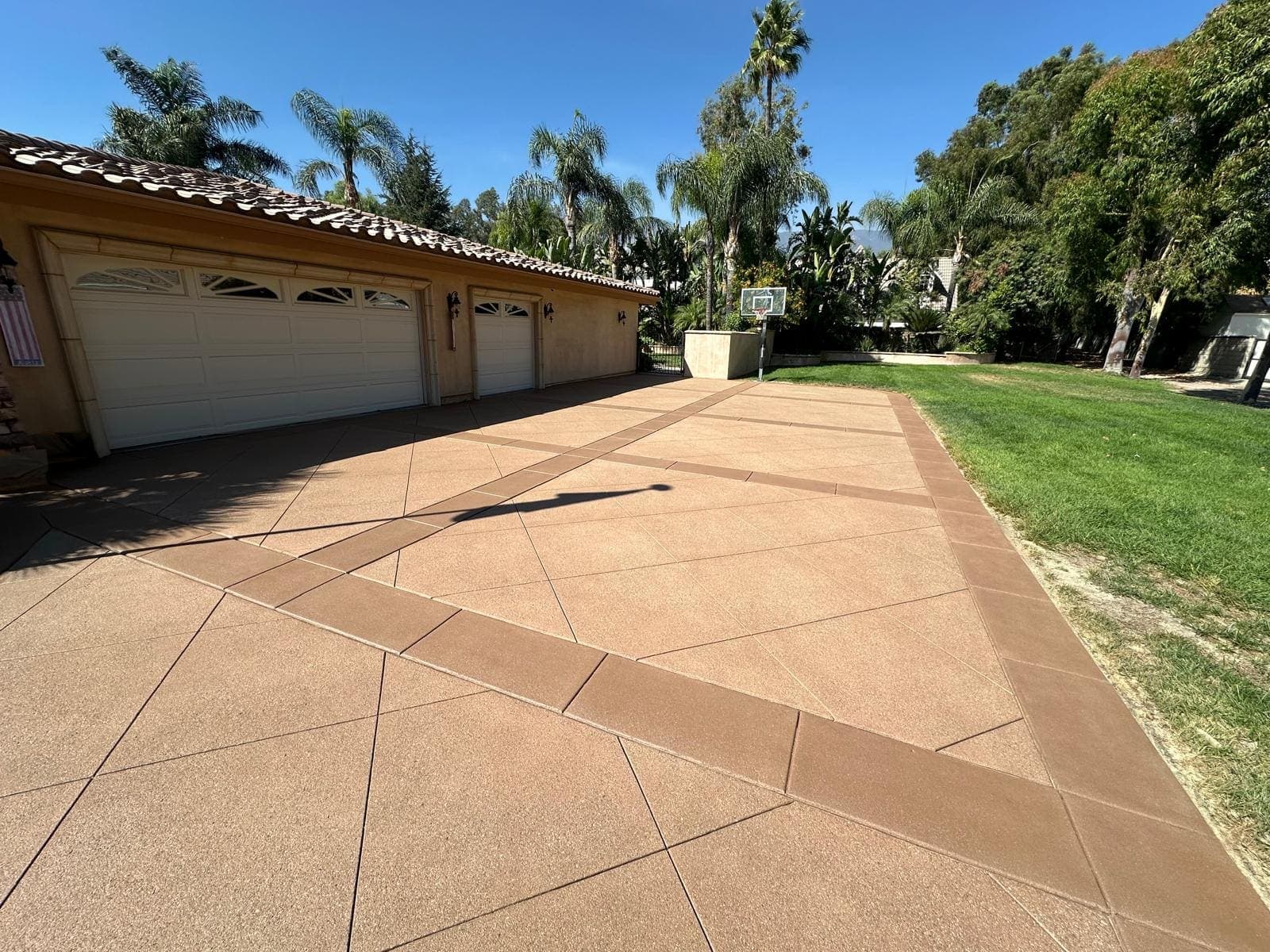
Finish options include a standard broom finish, integral color (mixed into the concrete itself, not just a surface stain, so it doesn't wear off), and stamped or tooled borders — the soldier-course border pattern shown below is a common request for tying a new driveway into existing stonework or garage architecture.
Every pour includes control joints cut at intervals sized to the slab thickness, and expansion joints wherever the new concrete meets the garage slab, a walkway, or the street apron — those joints are what actually control where the concrete cracks instead of leaving it to chance.
How it works
Step by step, here's what actually happens on site:
- 1Walk through and measure the driveway area, talk through finish and color options, and give you a written quote.
- 2Demo the old surface if needed, excavate to grade, and compact the base — this is the step that determines whether the driveway lasts 10 years or 30.
- 3Form, reinforce, and pour the slab with the finish you chose, then saw-cut control joints within the first day or two while the concrete is still workable.
- 4Let the slab cure — we'll give you an exact timeline for foot and vehicle traffic before we leave.
Why Peralta Concrete
We compact base in measured lifts and check it before we pour — not just eyeball it — because a driveway that heaves or cracks in year two is almost always a base problem, not a concrete problem.
Integral color and control-joint layout are planned before the pour, not decided on the fly, so the finished driveway looks intentional instead of patched together.
Our process
- 01
Consultation
Walk the site, listen to how the customer wants to use the space or solve the problem, and talk through rough budget and timeline — no pressure, no obligation.
- 02
Design
Put together a plan with real material choices and layout, sized to the actual property and budget, not a generic template.
- 03
Build
Crew handles the work to spec, with the owner checking in on progress at key milestones.
- 04
Walkthrough
Walk the finished work with the customer, confirm everything meets expectations, and cover care and maintenance before calling the job done.
Concrete driveway installation FAQ
How long before I can park on a new driveway?
Foot traffic is generally fine after a few days; we'll give you a specific date for vehicles based on the mix and weather, typically around a week for regular use, with the full 28 days to reach maximum strength.
Will the concrete crack?
All concrete develops hairline cracks over time — the goal isn't zero cracking, it's controlling where those cracks happen. Properly spaced control joints and a compacted base are what keep cracking to hairline joint lines instead of random cracks across the slab.