
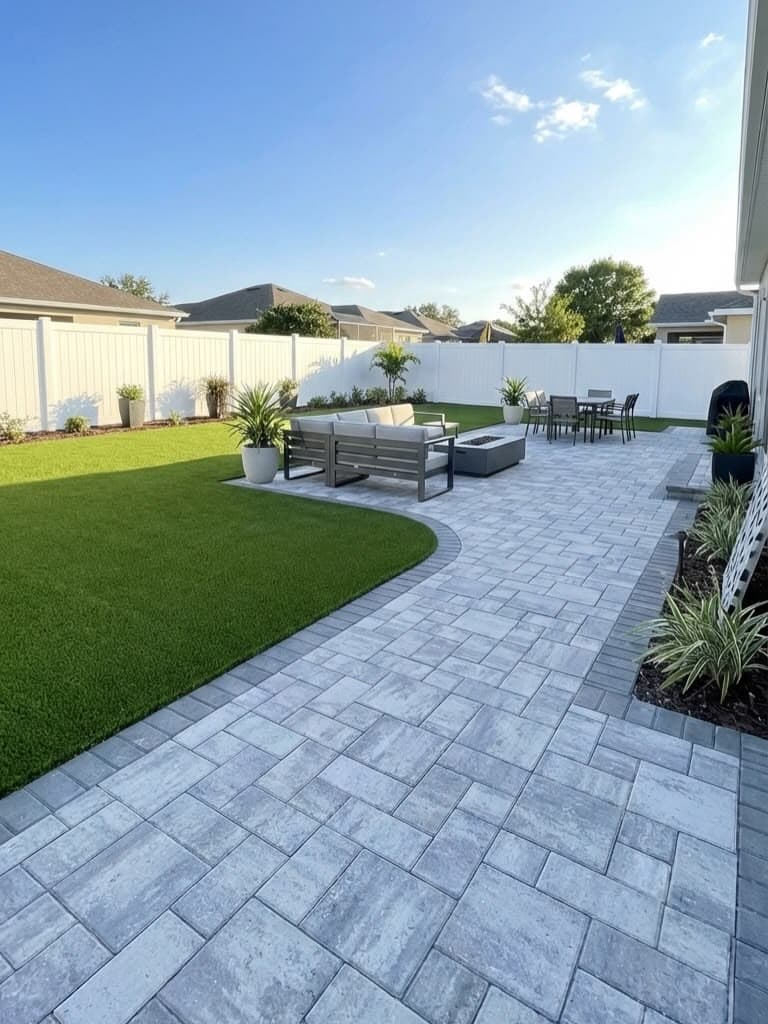
Paver patio installation
Built on a base that actually lasts.
Get a free quote
By submitting you agree to be contacted about your project. We respect your privacy. For faster service, call (213) 926-8243.
What's included
Pavers give you a durable, repairable surface — unlike a poured slab, an individual paver can be lifted and reset if it ever settles, without redoing the whole patio. That matters on Antelope Valley lots with mixed soil, where one section of a base can settle differently than another over time.
We excavate to grade, lay and compact a class II road base, then a leveling layer of bedding sand, before setting the pavers in the chosen pattern. Edge restraint — a rigid plastic or concrete curb around the perimeter — is what actually keeps the pattern locked in place over years of use; skipping it is the most common reason paver patios spread and gap over time.
Joint sand (polymeric, in most cases) locks the pavers together and resists weed growth between joints better than plain sand.
How it works
Step by step, here's what actually happens on site:
- 1Walk the space, choose a paver style and pattern, and talk through how it connects to turf, a pergola, or the rest of the yard.
- 2Excavate, compact the base, and screed a level bedding layer.
- 3Set the pavers in pattern, cut borders to fit, and install edge restraint.
- 4Compact the finished surface and sweep in polymeric joint sand.
Why Peralta Concrete
Edge restraint on every perimeter — it's an easy step to skip and the main reason cheaper paver jobs spread and shift within a few years.
Pattern and paver color planned to work with turf, concrete, or existing hardscape already on the property, not chosen in isolation.
Paver patio installation FAQ
Can pavers handle Antelope Valley ground movement better than concrete?
In areas with more expansive soil, yes — a paver surface can flex slightly and individual pavers can be reset if needed, where a concrete slab would crack. We'll tell you honestly which material fits your specific lot.
Do paver patios need regular maintenance?
An occasional rinse and, every few years, a fresh application of polymeric sand in the joints is about all they need.